



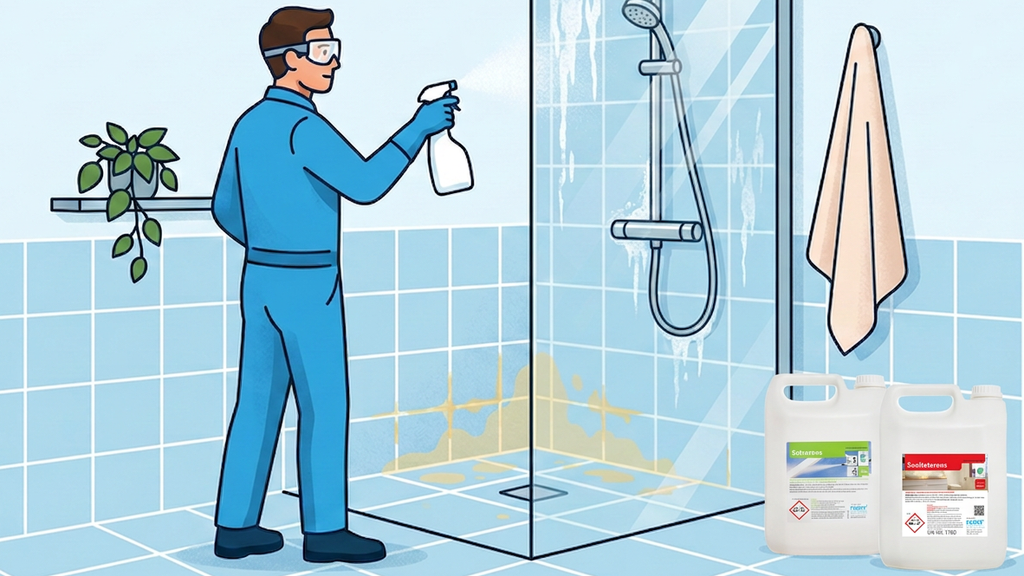
You’ve probably been there: you’ve scrubbed and scrubbed with soap, but the stains are still there. In such cases, it’s rarely down to a lack of effort. It’s down to the chemistry. Everything you’re trying to wash away falls somewhere on the pH scale, and if you use a cleaning product at the wrong end of the scale, you’re simply working against yourself. Here’s the pH scale explained in one minute, along with the method that tackles both grease and limescale.
Why isn’t the soap working?
Because dirt isn’t just one thing. Limescale dissolves sour agents. Fat is dissolved by alkaline cleaning products. They are at opposite ends of the pH scale, and one product cannot tackle both. A classic example: a brand-new washbasin covered in limescale streaks won’t come clean, no matter how much you scrub with ordinary soap. Spray on an acidic cleaner, wait half a minute and wipe it off. Gone.
How to remove both grease and limescale from your shower
In the shower, you often need two cleaning products, as there are two types of grime left behind. Soap scum and skin oils tend to build up at the bottom of the walls and in the grouting in the shower corner. Limescale tends to build up on glass, tiles and fittings. This applies to the bathroom at home, and even more so in changing rooms, swimming pools and gyms where many people shower every day.
- Start with an alkaline degreaser where grease and soap scum accumulate: at the bottom of the walls and in the grout in the shower cubicle. Wash and rinse.
- Switch to an acidic agent where limescale builds up: on glass, tiles and fittings.
- Leave the product to work for a short time. Half a minute to a minute is usually enough. You shouldn’t need to scrub hard.
- Rinse thoroughly with water. This step is important, particularly in the joints.
That’s why you need to rinse thoroughly
- Acidic substances left in the grout can corrode the cement. Over time, this can cause the grout to come loose.
- Leave the product to work for a short while, then rinse it off completely.
The pH scale in one minute
The scale ranges from 0 to 14, with 7 being neutral. Anything below this is acidic, anything above is alkaline (basic). It is worth noting that the scale is logarithmic: each step represents a tenfold increase in strength. A substance with a pH of 2 is therefore ten times more acidic than one with a pH of 3, and a hundred times more acidic than one with a pH of 4. Small numbers on the label can therefore make a bigger difference than they appear to.
| pH | Type | Typically resolves | Example from the range |
|---|---|---|---|
| 0–3 | Very sour | Limescale and limescale streaks, rust stains on toilets and porcelain, concrete residue and cement spills | Sanitary cleaner Swan label (pH 1.5) |
| 4–6 | Slightly acidic | Light limescale deposits and daily cleaning of sanitary facilities | |
| 7 | Neutral | Daily cleaning of delicate surfaces, window cleaning | Clean water or a drop of pH-neutral soap |
| 8–11 | Slightly alkaline | Ordinary dirt and everyday cleaning | |
| 12–14 | Strongly alkaline | Grease and soap scum, soot and dirt, oil | Extrarens’ Swan Label (pH 12.9) |
HSE: Respect the edges
- At the extremes of the scale, the chemistry is corrosive. Strongly alkaline cleaning products break down grease, including the natural oils in your skin. Wear gloves and goggles when using strong cleaning products.
- Never mix acidic and alkaline products. Take particular care when using products containing acid or chlorine.
Further examples: what solves what?
Once you’ve got to grips with acids and alkalis, many everyday problems sort themselves out. Rust stains in the toilet and concrete residue after renovation are acidic territory. Grease in the kitchen, soot and oil are alkaline territory. And when it comes to cleaning windows, you need neither one nor the other: clean water or a drop of pH-neutral window cleaner and a good squeegee will give you sparkling, streak-free windows.
The right pH means less soap, less time and less scrubbing. This is good value for money for those who do their washing at home, and even better for those who do it professionally.
🎧 Fancy hearing more? We cover everything there is to know about pH on the Proff Podden. Have a listen «pH – The key to effectiveness» (29 mins).