



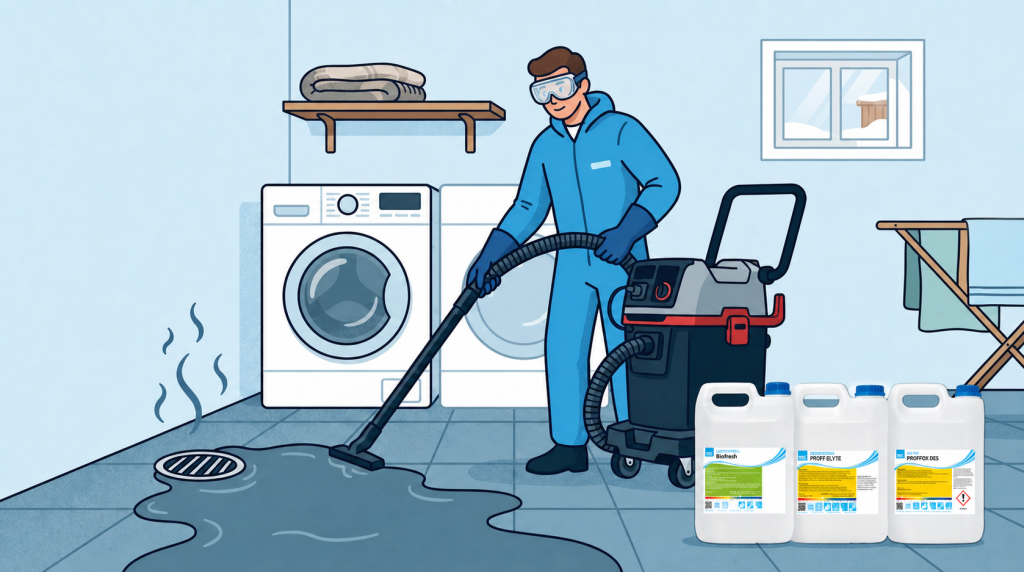
Sewer odours rarely disappear with ordinary cleaning. Following a backflow, leak or fault in the drainage system, the odour can become embedded in floors, walls, grouting, floor drains and other washable surfaces. In addition, sewage may contain bacteria, viruses and other infectious agents.
That is why the work must be carried out in the correct order. First, the source must be stopped. Next, the sewage and contamination must be removed, the surfaces must be washed thoroughly, the odour must be treated and the area must be disinfected. The aim is not to mask the odour, but to eliminate the cause of its recurrence.
This method is suitable for sewage and drainage problems where the odour is caused by backflow, leaks, drains, drainage faults or contaminated water on washable surfaces.
Sewage must always be treated as a potential source of infection. Do not commence chemical treatment until the source has been stopped and the area has been secured.
Important before you start
- Stop the leak, backflow or drainage fault
- Keep unauthorised persons and animals away from the area
- Wear chemical-resistant gloves, safety goggles or a face shield, protective overalls and boots
- Ensure there is good ventilation, and follow local procedures regarding infection control, waste and contaminated wash water
- Do not mix chemicals
- Only disinfect once the surfaces have been thoroughly cleaned
Odour control is ineffective as long as new contamination continues to enter the area.
Download the methodology poster as a PDF
Would you like the method summarised on a single page? Download the method poster for sewer odours and drainage damage. It contains the sequence of operations, safety points, product selection and a checklist for approval – designed to be printed out and used in the van, in the warehouse or out on a job.
Quick product selector
Use this as a quick guide before you start:
| Needs | Recommended product or equipment |
|---|---|
| Removing sewage and contaminated wash water | Water extractor with bilge pump |
| Dealing with sewer odours on washable surfaces | Biofresh |
| Disinfect clean, water-resistant surfaces | ProffOx DES |
| Disinfecting textiles or surfaces that are sensitive to bleach | Proff Elyte |
| Apply deodoriser in a controlled manner | Low-pressure sprayer or wet fogger |
Five steps to get rid of sewer odours
The order of the steps is the method itself. If you start disinfecting straight away whilst organic contamination is still present on the surface, the odour may return.
1. Secure the area and remove the source of the odour
Start by identifying the cause of the smell. It could be backflow from the drain, a leak, a blocked drain, a leaky joint, a faulty water trap, or sewage that has seeped into building materials.
Deal with the problem before you start any chemical treatment. Remove rubbish, sludge, loose debris and any materials that are still giving off an odour. Keep people and animals away from the area until the work is complete and the surfaces have been cleaned and disinfected.
2. Remove any sewage and wash thoroughly
Use a wet vacuum with a bilge pump to extract standing sewage and contaminated wash water. This makes the work safer and prevents the contamination from spreading further.
Then clean all washable surfaces mechanically. This means that the surfaces must be scrubbed, not simply dampened with cleaning products. Use a suitable cleaning method on floors, walls, grouting, drains, skirting boards and other areas where sewage may have accumulated.
The aim is to remove organic material before odour treatment and disinfection.
3. Treat the odour with Biofresh
Once visible dirt has been removed, the surfaces are treated with Biofresh.
Dilute Biofresh 1:10. Moisten the surface thoroughly using a low-pressure sprayer or a wet fogger. On stains, grout lines and areas with a noticeable odour, the product should be worked in with a brush.
Leave Biofresh to work for 5 to 30 minutes. Then rinse with lukewarm water. Repeat the treatment if the odour is still noticeable after washing, drying and airing.
4. Check before disinfecting
Before disinfecting, surfaces must be clean. Disinfection should not be used as a substitute for washing. Check that:
- Visible contamination has been removed
- No sludge, organic material or product residues remain
- The surfaces have been cleaned mechanically
- Surfaces and textiles that are sensitive to bleaching have been assessed prior to product selection
This step is important. If you disinfect too early, dirt and organic matter can reduce the effectiveness of the disinfectant and cause the odour to return.
5. Disinfect using ProffOx DES or Proff Elyte
Once the surfaces have been thoroughly cleaned, the treatment is completed with disinfection.
On clean, water-resistant surfaces, apply ProffOx DES mixed in a ratio of 1:2. The product should not be rinsed off. On textiles, furnishings or surfaces sensitive to bleaching, use Proff Elyte – a ready-to-use solution with a contact time of 1 to 5 minutes.
Choose a product based on the surface. ProffOx DES can cause discolouration and must not be used on textiles.
Key rules of chemistry
Certain mistakes are commonly made during sewer renovation. These should be avoided:
- Biofresh is not compatible with acidic cleaning products – always rinse thoroughly first if acidic products have been used
- ProffOx DES can cause bleaching and must not be used on textiles
- Do not mix chemicals
- Disinfection should always follow thorough washing
Why does the smell of sewage keep coming back?
Sewer odours usually return for one of three reasons.
The first is that the source has not been stopped. If a backflow could occur again, a joint is still leaking, or a drain is missing a functioning water trap, the odour and contamination will return no matter how thoroughly you clean.
The second reason is that organic material is left behind. It can become trapped in grouting, under skirting boards, around drains, in porous surfaces or in the drain itself. Odour treatment only works where the product can reach.
The third reason is that people skip the mechanical wash and go straight to using a deodoriser or disinfectant. This often masks the smell for a while, but does not remove it.
Scented products that merely mask odours do not solve the problem. Biofresh is used because it treats the source of the odour on the surface, but this requires that the area has first been cleaned and that the source has been removed.
Always reassess the odour once the surface is completely dry and the area is well ventilated. Damp surfaces may smell less than dry ones, so a job that appears to be finished immediately after washing may still require further treatment.
The products in the method
The method uses three chemical products, each with its own specific role: Biofresh for odour treatment of washable surfaces, ProffOx DES for disinfecting cleaned, water-resistant surfaces, and Proff Elyte where ProffOx DES may cause bleaching – for example, on textiles or more sensitive materials. In addition, a wet vacuum with a sump pump is used to remove sewage and contaminated wash water, and a low-pressure sprayer or wet fogger is used to apply Biofresh evenly.
Odour control and disinfection


Suction and application


When will the job be finished?
Do not assess the result until the area is dry and well ventilated. The job can be considered complete when:
- The source of the sewage smell has been stopped
- Sewage and contaminated wash water have been removed
- The surfaces have been cleaned mechanically, with no visible contamination remaining
- The odour has been assessed after complete drying
- Proper disinfection has been carried out
- There are no new odours coming from drains, sewers, grouting or hidden areas
If the odour persists, you must first check whether the source has been completely removed. You should then consider washing the items again, applying another Biofresh treatment, or disposing of any materials that cannot be salvaged.
In a nutshell
Sewage odours must be dealt with in the correct order. Stop the source first. Remove sewage and any contamination. Wash the surfaces thoroughly. Treat the odour with Biofresh. Finally, disinfect with ProffOx DES or Proff Elyte, depending on the surface.
Ordinary cleaning products or scented products are rarely sufficient. The odour will only disappear once the source has been removed, organic material has been washed away, and the surfaces have been treated and disinfected correctly. If you’re unsure which product to use, or whether the surface can withstand ProffOx DES, we can help you choose the right method.
If the smell is caused by urine, faeces, vomit or pests rather than the drains, you’ll find the method in Urine odours, faeces and pests: how to get rid of biological odours. A comprehensive overview of modern damage restoration can be found in From chaos to control.