



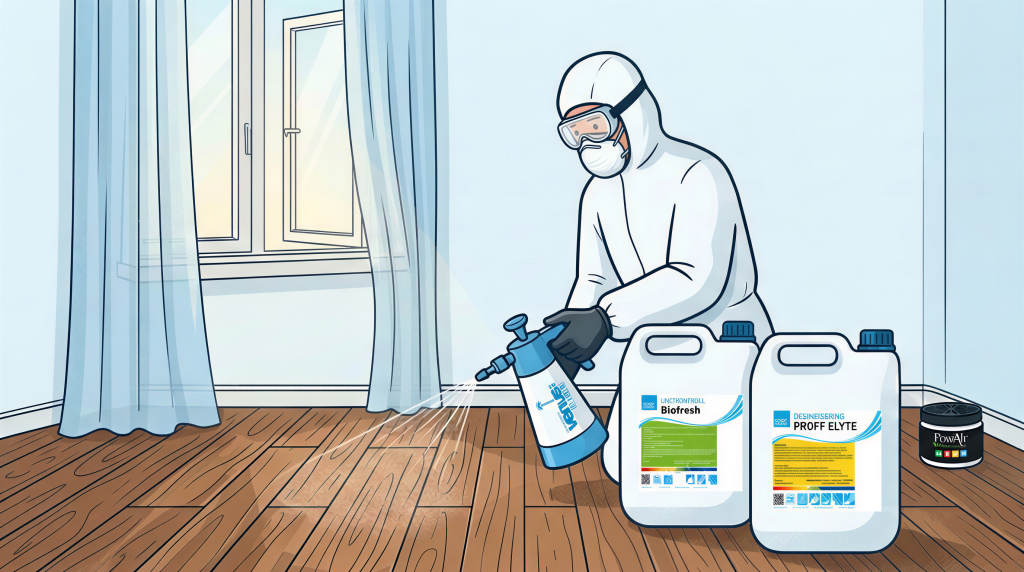
Corpse clean-up involves the removal of odours and contamination following a death, whether in a private home, a council flat, an institution or a car. It is one of the most demanding tasks in the decontamination sector, and a subject that is rarely discussed. The odour penetrates deeply into porous materials, textiles and surfaces that have been in contact with biological material.
Many people use chlorine to tackle the problem. It disinfects, but it bleaches fabrics, corrodes metal and equipment, is harsh on the skin and respiratory tract, and does not remove the source of the odour. The method below does the same job gently and safely, using two products and following a clear sequence: remove the source, apply Biofresh, wash, disinfect.
The disposal of corpses involves biological risks. The work must therefore be planned and carried out using appropriate protective equipment and with the area clearly cordoned off.
Important before you start
- Work will not commence until the deceased has been collected by the relevant staff
- Cordon off the area before handling the source, and assess the biological risk
- Wear chemical-resistant gloves, safety goggles or a face shield, full-body protective clothing and shoe covers
- Wear appropriate respiratory protection when spraying or fogging
- Keep unauthorised persons and animals out of the area, and do not mix chemicals
Download the methodology poster as a PDF
Would you like the full method in one place? Download the poster on corpse disposal. It contains all the steps, product selection, safety points and the procedure for vehicles – designed for in-house training and practical use out on assignments.
Why not just use chlorine?
Chlorine is the standard solution across much of the industry, whether for rooms, stretchers or equipment. It disinfects, but has three weaknesses when it comes to this particular task:
- The materials: Chlorine bleaches fabrics and, over time, corrodes metal, paintwork and equipment.
- Yourself: Chlorine vapour is harsh on the skin and respiratory tract and requires good ventilation.
- The smell: Chlorine disinfects the surface, but does not remove the organic material that is the source of the odour. As a result, the odour often returns.
The method below solves all three: Biofresh breaks down the organic material that causes odours, and disinfection is carried out using Proff Elyte, which can be used anywhere and does not bleach. Proff Elyte removes 99.999 % of bacteria, viruses and fungi, and is gentle on skin, fabrics and equipment. In cases of strong odours, and where surfaces are not sensitive to bleaching, it is ProffOx Des An alternative. If you need to disinfect the stretcher between jobs, spray it with Proff Elyte. If there has been any spillage, use Biofresh first, then disinfect.
Quick product selector
| Situation | Recommended product or equipment |
|---|---|
| Odour treatment of the affected area | Biofresh |
| Damage to textiles or carpets | Carpet cleaner with Biofresh |
| Disinfection of cleaned surfaces, stretchers and equipment | Proff Elyte |
| Disinfection where there is a strong odour, on surfaces that can withstand bleaching | ProffOx Des |
| Controlled application of chemicals | Low-pressure sprayer or wet fogger |
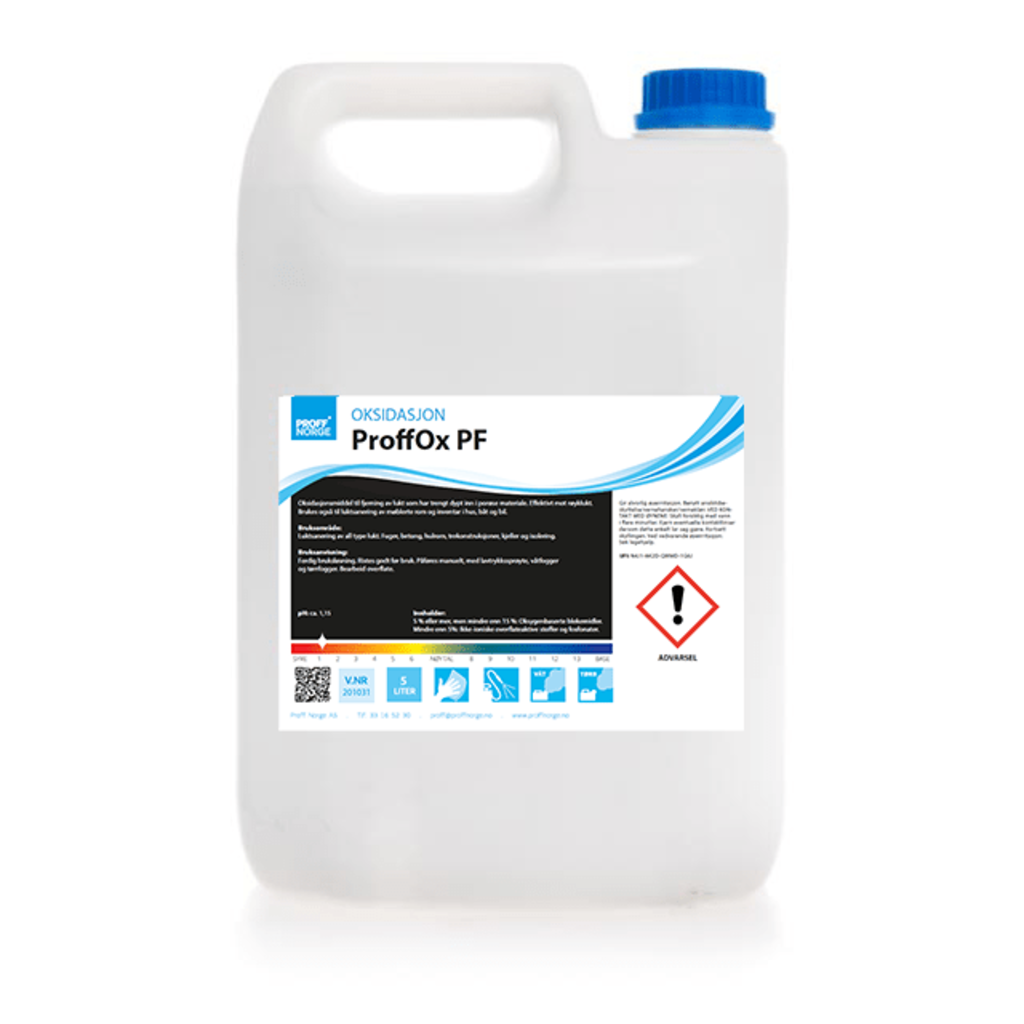
| Odours that persist despite the measures taken | Dry fogging with ProffOx PF |
Step-by-step body recovery
The order is important. Always remove the source first – the chemicals are intended to enhance the clean-up, not to mask any organic material or spillage that remains.
1. Remove the source
Remove all organic material and visible sources of odour or contamination. Items that cannot be cleaned properly, such as mattresses or heavily soiled textiles, should be considered for disposal.
2. Apply Biofresh and leave it to work
Spray Biofresh on the affected area. The product can be used either undiluted or diluted at a ratio of 1:10; the undiluted form is recommended for the worst-affected areas, such as where the deceased has been lying. Leave it to work for 5 to 30 minutes, or longer if the liquid has penetrated deeper into the material. It is important that the chemical does not dry out, as this will cause it to lose its effectiveness.
If the stain is on fabric or carpets, first spray Biofresh onto the affected area and leave it to work before going over the area with carpet cleaner with Biofresh. The carpet cleaner helps the product penetrate deeper into the fibres.
Odours from drains: Pour Biofresh directly down the drain and leave it to work. You don’t need to rinse it away.
3. Wash
When Biofresh Once it has had time to work on the surface, wash it off using Biofresh diluted 1:10 in lukewarm water.
4. Disinfect
Spray on Proff Elyte as a final treatment. Proff Elyte can be used anywhere and does not leave any stains. Apply using a low-pressure sprayer or a wet fogger. It works immediately, eliminating bacteria, viruses and odours.
An alternative to Proff Elyte is ProffOx Des, where there is a strong odour and the materials are not sensitive to bleaching.
The product should be left to sit and must not be washed off. Wipe away any excess product if necessary; the only residue is water.
5. If the smell persists after taking these measures
Check for any residue or spills. If you can’t find anything, move on to the next stage: heating and dry-fogging. This is the treatment for more serious cases, where the odour has become embedded in the structure.
Next steps: dry fogging when the odour persists
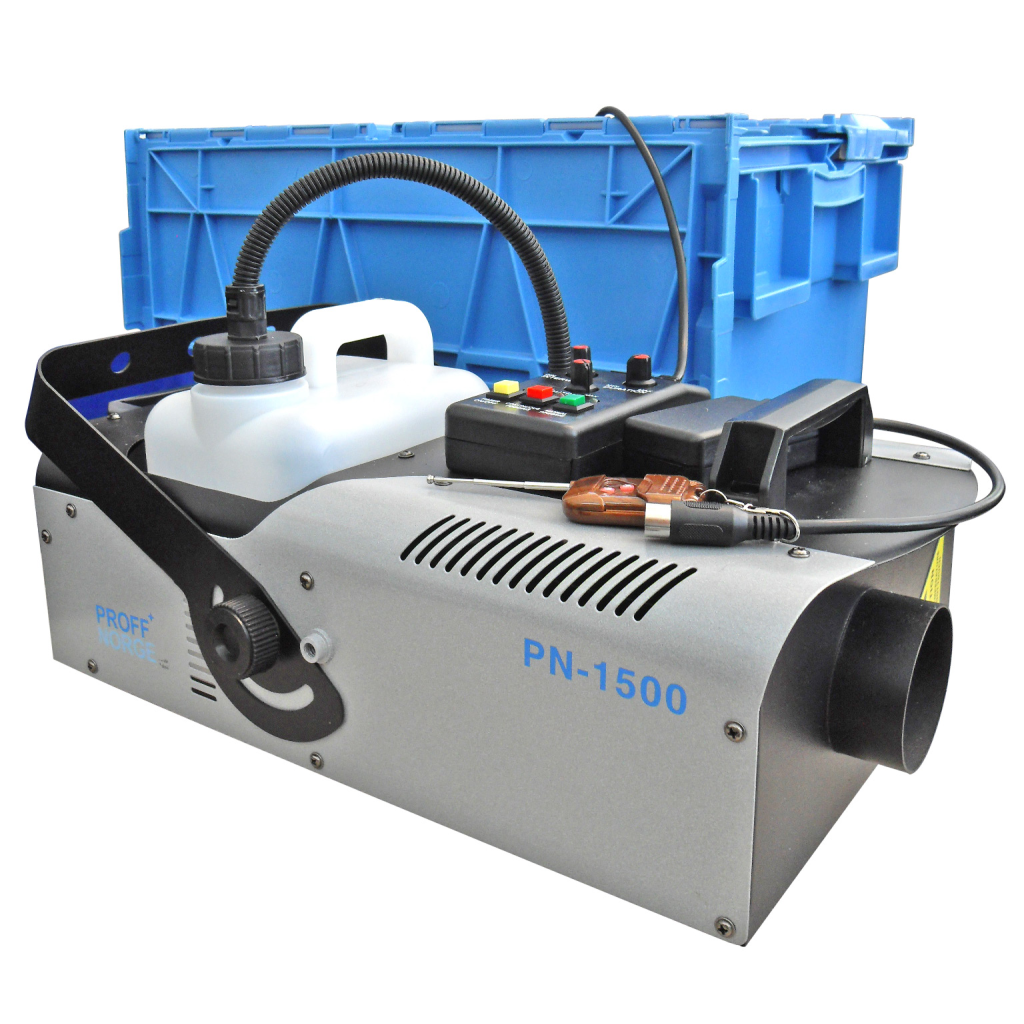
This is for the more experienced, and requires protective kit and thermal foggers. The procedure is as follows:
- Prepare for dry fogging. Close all openings to the outside and seal any ventilation ducts. Heat the house or room so that the pores in the materials open up – this allows the chemical to penetrate deeper.
- Prepare your protective equipment. Full-face mask with a combination filter, disposable coveralls, nitrile gloves and shoe covers.
- Dry fogging with ProffOx PF. Start at the innermost part of the building and work your way outwards. Fumigate the rooms thoroughly and leave it to work for 24 hours. ProffOx PF is odourless and is suitable for use in furnished homes and also in cars. A stronger alternative is ProffOx Max, which is more potent and oxidises more, but it is not used in furnished rooms or in cars.
- After the first fogging. Put your protective equipment back on and ventilate the whole house thoroughly. If the odour has gone, proceed to the final treatment. If it is still there, check again that all sources have been removed, and then carry out another round of treatment with ProffOx PF.
- Add a fresh scent if you wish, and carry out a final check. This final treatment is only carried out if you have the odour under control and wish to introduce a scent into an odour-free room. Choose one of the following two options: Dry fog with Dry odour removal – Pine needles, leave it to work for 24 hours and then air the room thoroughly. Use ‘Furunål’ in moderation; the product contains oil, and using too much may leave a thin film of oil on the walls and floor. Or take it outside PowAir odour boxes In the most exposed rooms, these do not require ventilation. Do not use both, as this will mix the two odours. Carry out a visual inspection and an odour check at the end.
Important points to note when using dry foggers
- No people without protective equipment, animals or plants are to be present in the room during fogging. Switch off ventilation and any sources of ignition.
- Rinse the grout applicator with clean water for a couple of minutes after use. Do not leave it with the cleaning solution for more than 10 minutes before rinsing it.
Is it about a car?
The procedure is the same in a car as it is in a room: spray and clean with Biofresh on the affected area, and disinfect with Proff Elyte, which does not bleach fabrics. If the seats are made of fabric, we recommend using a carpet cleaner containing Biofresh. Biofresh must not be used on genuine leather; leather seats should be washed with a mild soap, such as Unisåpe. You can find the detailed procedure for cars, including dry fogging and ozone treatment, in the method poster available for download on this page.
The products in the method
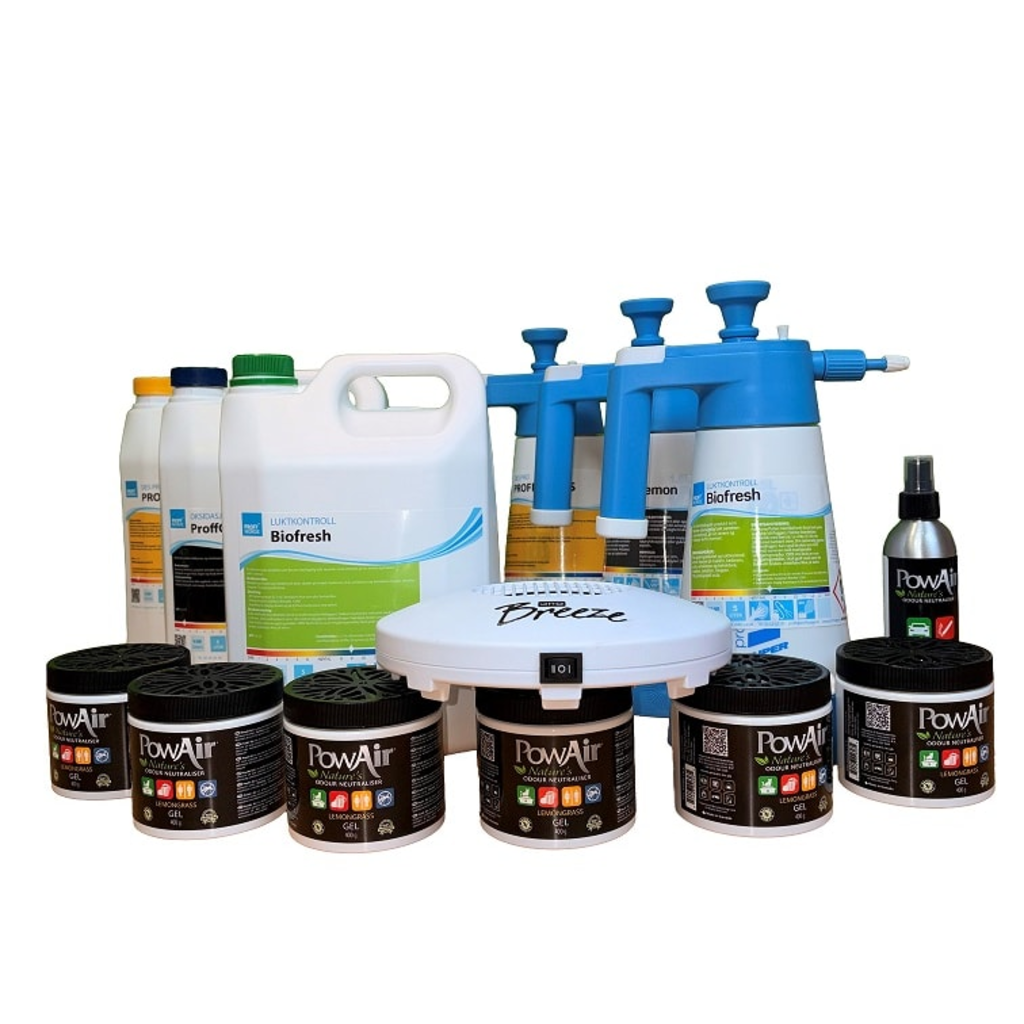
Biofresh is the odour treatment: it breaks down the organic material that causes odours, and is used both for application and washing. Proff Elyte It disinfects the cleaned surfaces, can be used anywhere and does not cause discolouration. ProffOx Des is an option for strong odours, where the surfaces are not sensitive to bleach. A pump bottle and a wet mop allow for controlled application, and ProffOx PF Thermal foggers are used in the subsequent stages when the odour is trapped within the structure.
All in one package
The chemistry of the procedure


Application and subsequent procedure


In a nutshell
Pest control should be carried out in the correct order using two products: Remove the source first. Apply Biofresh and leave it to work without letting it dry out. Rinse off with Biofresh diluted 1:10 in lukewarm water. Disinfect with Proff Elyte, or ProffOx Des where the odour is particularly stubborn and the surfaces can withstand bleaching. If the odour persists, move on to heating and dry fogging. This method is gentle on both you and the materials, and unlike chlorine, it removes the source of the odour.
If the odour is of a biological nature, such as animal carcasses or rotten food, see the method in Odour control for biological odours. If you’re unsure about which method or product to choose in a specific situation, we’d be happy to help.